
News & Events
How can payment models support more seamless, interoperable and user-friendly EV charging services across Europe?
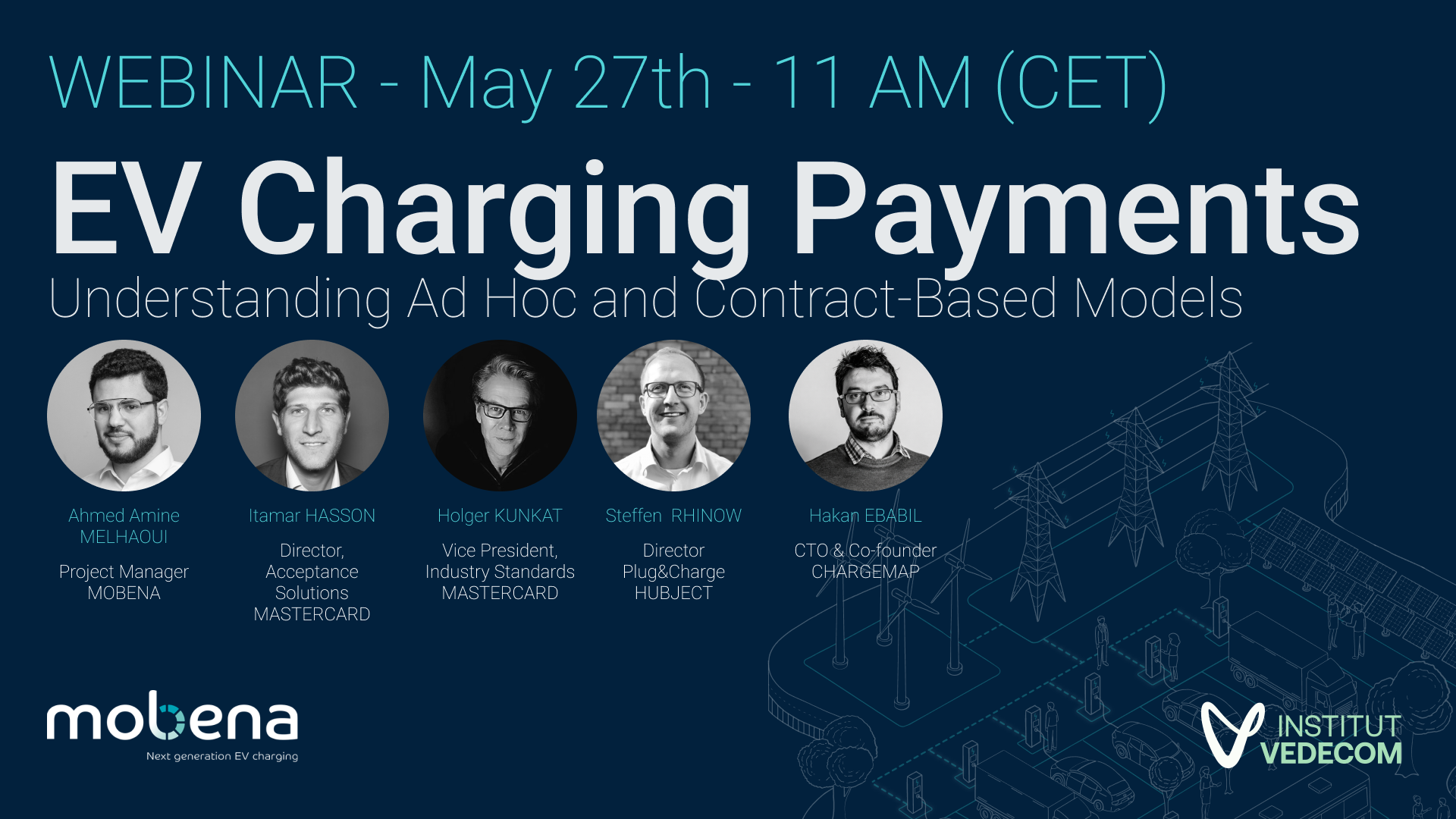
On May 27th, MOBENA-X hosted a webinar dedicated to one of the key challenges of the electric mobility ecosystem: EV charging payments.
The session brought together experts from Hubject, Mastercard and Chargemap to explore the different payment models currently shaping the market, such as ad hoc and open-loop payments.
Understanding payment models in a changing EV charging ecosystem
As EV charging services scale up across Europe, payment is becoming an important topic for the entire ecosystem. It directly impacts user experience, interoperability, cybersecurity, system architecture, stakeholder roles and market accessibility.
The objective of this MOBENA-X webinar was to provide a clear overview of the main EV charging payment models, without endorsing one specific approach.
The session focused on three complementary perspectives:
– Direct Payment for Plug&Charge, presented by Steffen Rhinow (Hubject)
– Ad hoc and open-loop payments models, including EMVCo EV Open Payment initiative, presented by Holger Kunkat and Itamar Hasson (Mastercard)
– The eMSP user journey, from charging station discovery to payment, presented by Hakan Ebabil (Chargemap)
Together, these contributions clarified how different payment models can coexist to enable a more seamless charging experience for EV drivers. They also highlighted that the user journey involves multiple steps—from locating available charging stations to completing the payment—thereby emphasizing the key role of eMSPs in enhancing the overall user experience.
Plug & Charge Direct: adding payment flexibility to an existing ecosystem
Hubject opened the discussion by presenting how direct payment can used with the Plug & Charge service.
The key idea is not to replace contract-based charging, but to extend the existing Plug & Charge experience with an additional payment option. In this model, users can associate a payment card with their vehicle experience and benefit from a seamless charging flow: selecting an eligible charging station, plugging in, charging, and receiving a receipt after the session.
One important point highlighted during the presentation is that this approach leverages the existing Plug & Charge ecosystem. According to the presented model, CPOs do not need to modify their backend or update EVSE firmware. The service can be enabled through configuration, while payment, invoicing and settlement are handled through the dedicated service layer.
This illustrates a broader trend in the EV charging ecosystem: improving user convenience while limiting deployment complexity for infrastructure operators.
Open-loop payment and the EMVCo EV Open Payment initiative
Mastercard then presented the role of open-loop payment models in EV charging.
Open-loop payments aim to allow drivers to use existing payment credentials, such as payment cards or digital wallets.
The presentation highlighted the EMVCo EV Open Payment initiative, which explores how EMV technologies can support open, secure and seamless EV charging payment experiences. This model builds on existing standards and technologies such as ISO 15118 and Secure Remote Commerce, with the objective of supporting card-based payments within Plug & Charge frameworks.
Several key principles were discussed:
– interoperability across vehicles, charging stations and payment networks;
– consumer choice in payment credentials;
– secure use of tokenized payment data;
– reduced PCI compliance burden for charging stations and operators;
– coexistence with other payment options, including ISO 15118 contract-based payments.
Mastercard also presented ongoing work around its in-car commerce platform, with pilots planned to further test and enable this model across different charging environments.
From discovery to payment: the eMSP user journey
Chargemap broadened the discussion by reminding participants that payment is only one step in the overall charging journey.
Before paying, drivers need to find a charging station, check availability, understand charging power, assess nearby services, start the session and monitor charging progress. A successful payment experience therefore depends on the quality of the entire journey.
From the eMSP perspective, the challenge is to simplify the experience while adapting to different user needs and charging contexts. Chargemap highlighted several possible ways to start a charging session, including Plug & Charge, Autocharge, remote charging, open-loop cards and RFID cards.
The presentation also introduced the emerging role of the EVSO, which could help integrate eMSP services more directly into the vehicle. This would make it possible to display charging station data, tariffs, route planning information, charging history and personalized services directly within the in-car experience.
For drivers, this could mean greater freedom of choice, more transparency and a more seamless charging experience. For eMSPs, CPOs and OEMs, it opens new opportunities to improve service quality, optimize infrastructure usage and reduce operational complexity.
Key takeaways from the discussion
The webinar confirmed that EV charging payment is not a one-size-fits-all topic. Different models respond to different needs, and their coexistence will likely be essential to support mass-market adoption.
Several key points emerged from the discussion:
– Payment models must support consumer choice. Drivers should be able to choose the most relevant payment method depending on their context: private trip, professional use, fleet needs, occasional charging or subscription-based charging.
– Interoperability remains central. Whether through Plug & Charge, open-loop payment or eMSP-based services, the success of these models depends on robust interoperability between vehicles, charging stations, CPOs, eMSPs, payment networks and roaming platforms.
– Transparency is critical for user trust. Tariff complexity remains a barrier. Clearer pricing information, displayed in apps, vehicles and charging stations, will be essential to improve confidence and adoption.
– The vehicle is becoming a key interface. As charging services become more connected, in-car integration will play a growing role in simplifying the user journey and making charging more intuitive.
– Future services will increase complexity. Smart charging and bidirectional charging will create new requirements for authorization, billing, compensation and data exchange. Payment systems will need to evolve alongside these new use cases.
MOBENA-X: supporting interoperable and trusted EV charging services
This webinar reflects MOBENA-X’s mission: bringing together key stakeholders from the electric mobility, energy and infrastructure sectors to address interoperability and cybersecurity challenges and accelerate the deployment of next-generation EV charging services. By creating spaces for technical exchange, shared understanding and ecosystem alignment, MOBENA-X contributes to the development of a more open, secure and user-oriented EV charging market.